The funny thing is — I chose fundamentalism.
I was looking for meaning in a chaotic world.
I came in on fire, thinking it was for God but later discovered it was for my own ego. I proudly compared myself to Peter. I was feisty for the lord, hand on my sheath, sword at the ready.
I was in denial. I didn’t see myself as fundamentalist because I believed deeply in openness, love and understanding.
I wanted to tear down the establishment from the inside. I wanted people to hear my truth.
But, really, underneath it all, I was searching for validation and a sense of belonging.
Plagued By What Ifs
I had attended church with my grandmother as a child. By choice. I went with her every Sunday to a Cumberland Presbyterian church just a few miles down the road from home.
I saw families who seemed to have it all figured out. They enjoyed serving together. They stayed for fellowship meals, came for Bible study and youth group, they sang in the choir, taught Sunday school, served as elders.
And I wanted that. It had been an unspoken life goal of mine — to find that sense of spiritual community that others seem to have.
I have always been an anxious mess of a person. Anxiety fueled sleepless nights, horrific dreams when I did sleep and a lot of nervousness and overthinking by day. “What if” plagued me.
I never knew how to calm that part of my brain, teach it that we can just be peaceful and joyful. We didn’t have to live in a constant state of being under attack.
Worries consumed me. Floods. Fires. Wars. Kidnapping; I imagined waking up stranded on a cliff, a bottomless abyss on one side, a wall on the other. Absurd and unrealistic, but the fear was real. How could someone get me there? And without waking me? There isn’t even a canyon or cliff of this sort nearby.
Still, I didn’t know how to make those intrusive and obsessive thoughts cease.
As I got older, the compulsive thoughts began. The dreams got worse. At times during my teen years, it was hard to tell dreams from compulsive thoughts. Which had come during waking hours and which had slipped in as I attempted to slumber.
I guess it could have been worse. Many people begin to self medicate with substance abuse. Instead, I chose to lean into the obsessive tendencies. Everything had to be even, to the point if I scratched one knee I scratched the other in the same place. I wouldn’t turn off my vehicle if the windshield wipers had swept an odd number of times as I drove. I needed balance.
I threw myself into school, and not just academics, but activity upon activity. I sang in the choir, acted on stage, played softball, art club, Beta club, National Honors Society on top of honors and AP classes. I genuinely enjoyed my activities, but I often wonder now if I wasn’t just attempting to distract myself from the anxiety. Or, at least redirect it into something I could control in my life.
Still, the thoughts continued.
In college I attempted to pull back and focus on the activities that would benefit my career in newspapers. I wrote for the newspaper, I worked in the library as a research assistant (and later as a research assistant to a professor), and I took on extra courses that would help me in my career as a writer.
I made a lot of bad decisions. Then some worse ones.
I was spiraling, still struggling to find a way to quieten the thoughts, find peace, find calmness.
I remember the song from Bible school as a child, “I’ve got peace like a river in my soul.” I’d sing it with conviction, not because I had peace like a nice, relaxing comforting river, but because I longed for it.
The inner river in my soul apparently faced a lot more rapids than your average person. A lot of waterfalls too.
Others had peace. So I must be doing something wrong.
I’d try something. Fail. Try something else harder. Fail.
I had to be the problem.
High Stakes in Low-Stakes Poker
In my 20s, sitting at a low-stakes poker game until the wee hours of the morning, I felt like I was the only one who hadn’t unlocked life’s big secret.
They were all Seventh-day Adventists. They were happy, joyful, calm (mostly) and at peace. They weren’t plagued by the “what ifs” like I had been for as long as I remembered.
Turns out, the stakes were surprisingly high for a low-stakes poker game between friends.
And that’s when my life began to change.
My constant anxiety drove me to seek a sense of control and stability, which I believed I could find in the Adventist church. The strict rules, rigid schedules and emphasis on conformity provided a temporary sense of security.
I began throwing that same fervor and drive that made me a good student into religion. I studied the Bible with passion, searching for meaning, believing it was the Absolute Truth and there were no deviations, no room for interpretation. I prayed with a renewed conviction.
I stood at the precipice of unlocking all the answers to our purpose here on earth. I firmly believed in the Sabbath and in the third angel’s message. I clung to the message of health. I told myself I had a servant’s heart, made meals, joined the children’s ministry, taught Sabbath school. I posted well-intended messages on Facebook. I wanted to share what I had finally found.
I proudly shared a praise one Sabbath in church. We’d made a hard decision to pay tithes even though we only had $18 in our checking account. Then we came home and checked the mail to find an unexpected check for $50, enough to get gas to get us through another work week. Our faithful giving had been rewarded, you see. Praise God. Hashtag blessed.
Despite the outward appearance of faith and gratitude, something was still missing. My chest was tight, and I was obsessively running my budget in my head. The church had taught me to pray when I felt anxious, but it seemed like an empty gesture.
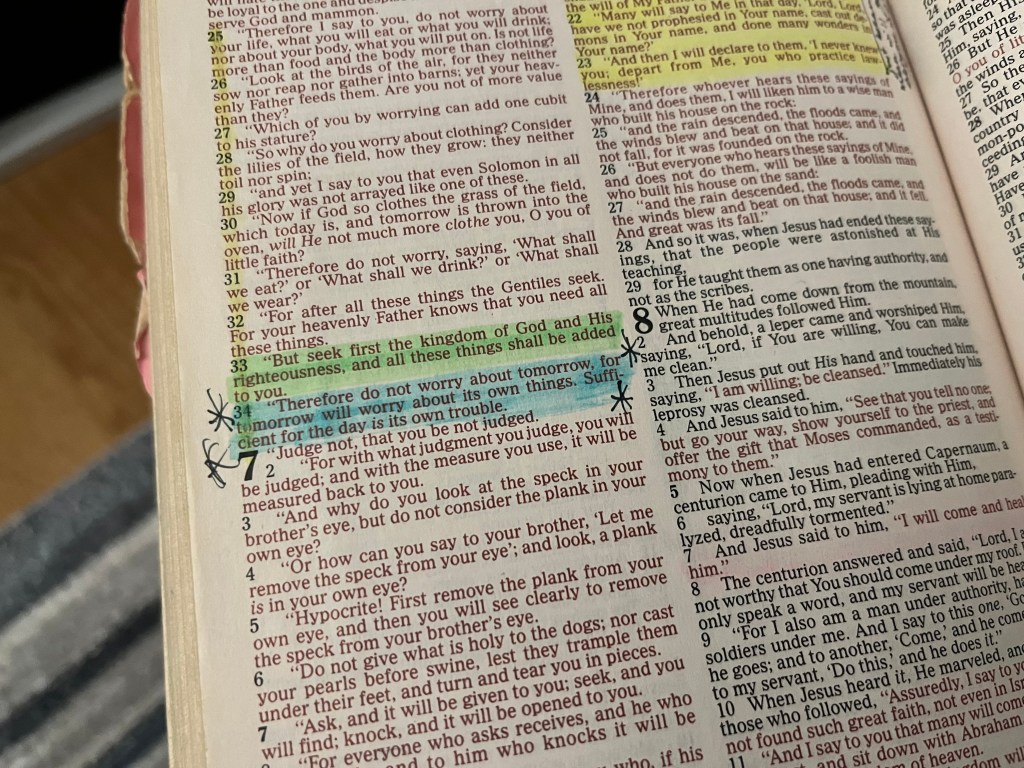
Philippians 4:6 tells us not to worry or be anxious (depending on the translation you use) but instead to pray. I wrote Matthew 6:34 everywhere I could think of as a little reminder to myself: “Therefore do not be anxious about tomorrow, for tomorrow will be anxious for itself. Sufficient for the day is its own trouble.” I highlighted it in blue and starred it in my favorite little pink Bible.
The very place I had sought for peace and comfort was leaving me feeling more alone and inadequate.
Outwardly, I smiled and pretended my faith was carrying me through. Inside, I wondered what I was — once again — doing wrong.
Behind the Mask
I was still having panic attacks, intrusive and compulsive thoughts, horrific dreams, sleep paralysis and all around nighttime issues.
Church wasn’t a cure. My years of Bible study, prayer, service and unwavering financial support hadn’t removed any of my anxiety and hadn’t provided stability.
In addition to my inner turmoil, the church’s stance on women in leadership was a constant source of frustration. It seemed certain men in charge had forgotten that the church itself was founded by a woman. The notion that a woman’s anatomy made her unfit for certain roles should be a relic of a bygone era. But the patriarchy persists.
(I don’t get it. Does the patriarchy think the penis is an antenna that allows men to receive God’s message? Anyone remember Deborah from the book of Judges?… but I digress…)
Then when same-sex marriage was finally legalized in the United States, the church decided to speak out against the LGBTQ+ community. I didn’t understand that level of division and discrimination coming from a group that claimed to represent God’s love. Why were people focused on condemning and excluding people when we should be spending our energy loving others and helping others?
The stance against same-sex marriage represented a culmination of years of disappointment. I had to step away — for my own well-being.
I had chosen this path. I believed this would give me the answers I needed, that I was searching for. I pretended for many years that it had.
I felt empty, worthless, and more alone than ever before.




 Misty D. Watson
Leave a comment